
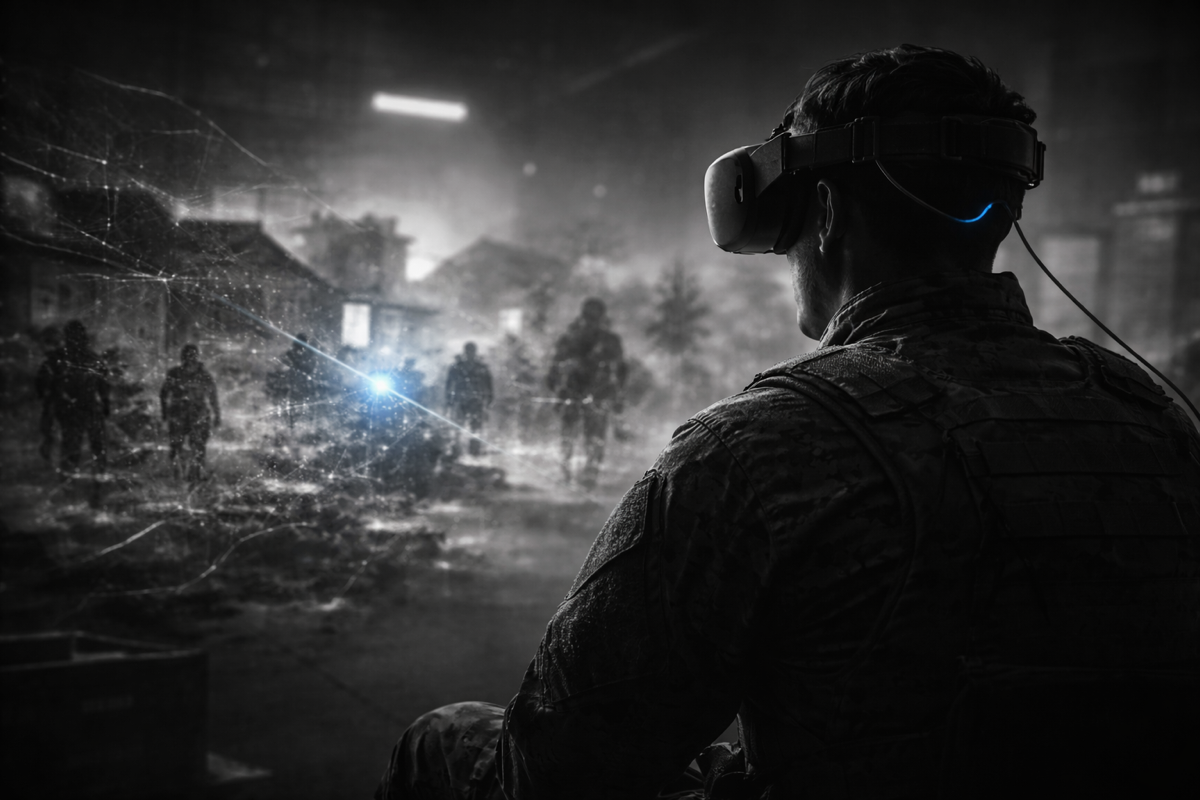
Picture this: A soldier straps on a headset in a secure facility. The metaverse loads a hyper-real village. Avatars scream as digital forces sweep through, executing orders that mirror historical genocides. It's not entertainment. It's classified training, designed to build resilience against atrocity-level threats in asymmetric warfare. Feels detached, like a video game. Until the data leaks.
This isn't dystopian fiction. Military VR already simulates brutal scenarios for ethical desensitisation checks, decision-making under fire, and tactical prep. Add quantum-powered rendering for unpredictable enemy behaviours, and these sims predict real-world outcomes with terrifying precision. The goal: Prepare forces for the worst without real blood. The hidden cost: Massive troves of behavioural data, neural response logs, and scenario blueprints stored in systems vulnerable to nation-state hacks.
Information risk explodes here. A single breach hands adversaries predictive models of Western military psychology, response patterns, and moral breaking points. Terror groups could reverse-engineer the sims for recruitment propaganda or attack rehearsals. State actors might use stolen datasets to craft disinformation campaigns that exploit trained desensitisation. What starts as pixels becomes geopolitical ammunition.
The quantum twist amps this danger profoundly. Quantum computing doesn't just speed up simulations – it shatters classical encryption protecting them. Future qubits could decrypt today's "secure" training archives overnight. Nations racing toward quantum supremacy aren't just building better computers; they're staging a silent heist on each other's virtual battlefields. Quantum stagecraft turns metaverse sims into fragile fortresses, where one cryptographic collapse exposes entire defence postures. Imagine quantum-enhanced sims modelling not just troop movements, but probabilistic ethical dilemmas – branching realities where a single decision tree reveals a commander's breaking point. Adversaries with quantum access could simulate countermeasures against our simulations, creating a meta-layer of warfare that's one step ahead. This elevates information risk to existential levels: Leaked quantum sim data doesn't just inform enemies; it lets them preempt our every virtual move, turning preparation into prediction.
Legal lines blur faster than the tech evolves. Current international law targets real harm. The Rome Statute defines war crimes by intent and effect in the physical world. But what if an AI-monitored sim flags a trainee's avatar directing mass executions with unusual zeal? Does repeated "crossing the line" in VR signal real risk, warranting intervention? Or is it protected training? Propose built-in AI jurors that log intent markers – facial micro-expressions via headset cams, hesitation patterns, override frequency. These become digital evidence chains. Hackable, forgeable, weaponizable. And with quantum decryption looming, even encrypted juror logs turn into open books for hostile intelligence, amplifying the information risk at the heart of accountability.
Humanise the stakes. Veterans report VR training leaves lingering unease, blurring virtual kills with real memory. Desensitisation works both ways: It toughens operators but risks ethical erosion. If leaked modules show Western forces practising "genocide containment" scenarios, adversaries spin them as proof of hypocrisy, fuelling radicalisation. Counterterrorism flips to counter-narrative failure, all because simulation data escaped containment.
Geopolitics gets weirder. Envision a Metaverse Geneva Convention – virtual summits where diplomats duel in shared sims to negotiate rules of digital engagement. Test war crime boundaries without escalation. Sounds elegant. Reality: Platforms become espionage honeypots. Shared code embeds backdoors. Quantum vulnerabilities turn talks into data exfiltration ops. International relations hinge on who secures the sim layer best – and with quantum actors like China advancing rapidly, the imbalance could leak Western diplomatic strategies before they're even deployed.
Intelligence communities already eye this. VR treats PTSD by controlled re-exposure; flip it, and sims could radicalise. Extremists might infiltrate open platforms, running "training camps" disguised as games. Law enforcement calls for metaverse oversight, but without ironclad info risk controls, regulation becomes another leak vector.
The core truth: In this frontier, information isn't supporting the fight – it's the fight. Every byte of training data is a national security asset with outsized downside. Secure it with zero-trust architectures, quantum-resistant encryption, and mandatory "data sovereignty" clauses in sim contracts. Or watch adversaries train on our nightmares.
Policymakers, tech builders, ethicists: Time to treat metaverse sims like nuclear blueprints. Classify, compartmentalise, audit relentlessly. Because when pixels train killers and leaks arm them, the first casualty isn't flesh – it's the information edge that keeps us safe.