
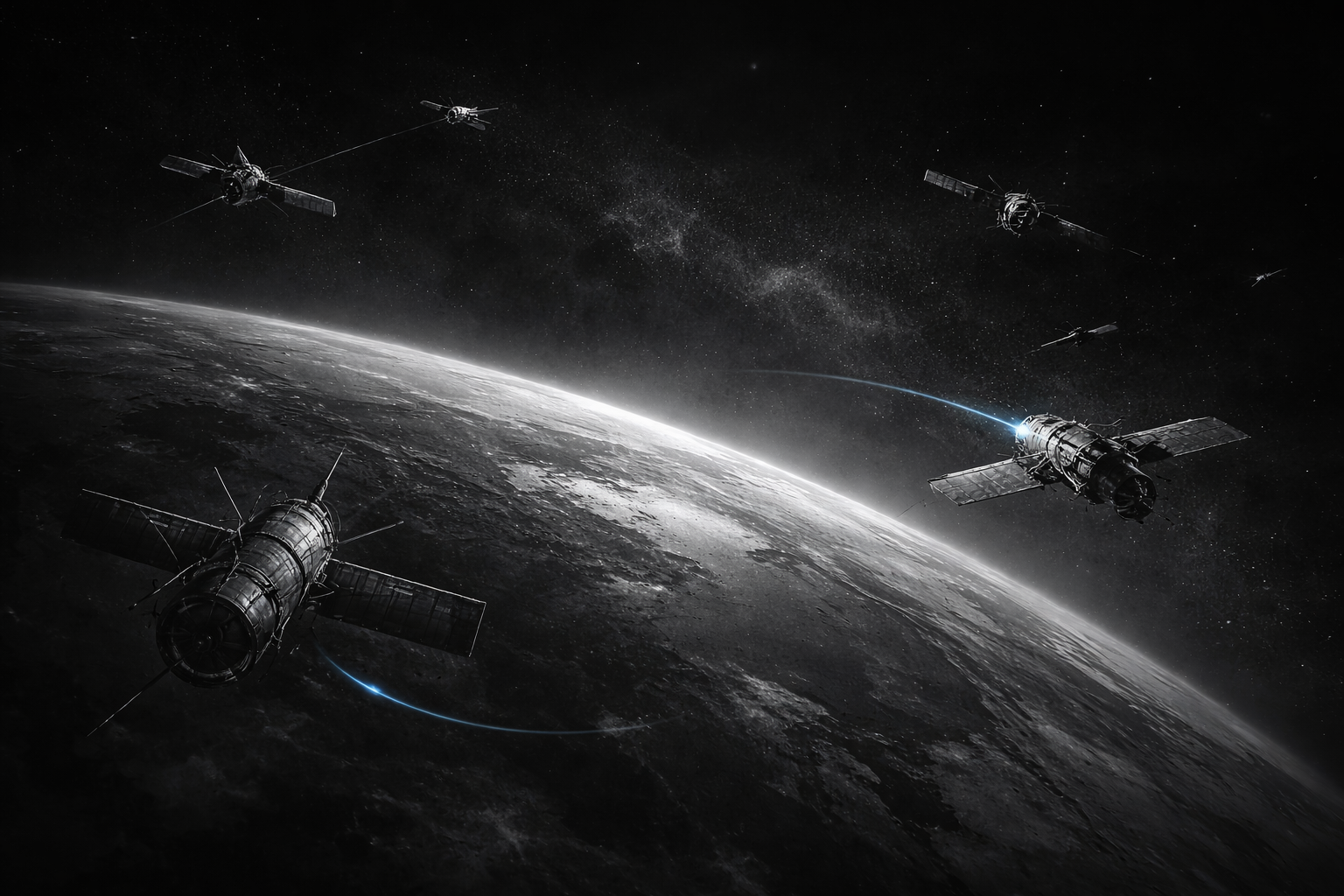
High above Earth, thousands of relics from the Cold War tumble through the void in silent orbits. These zombie satellites - US Corona series birds that once dropped film canisters packed with reconnaissance shots, Soviet Cosmos platforms that sniffed signals across the Iron Curtain, declassified programs like JUMPSEAT and HEXAGON, drift as defunct hulks. Many still hold structural integrity, with faint carrier signals leaking or telemetry echoes persisting long after official shutdown. Picture the graveyard as a vault of forgotten data: baselines for missile trajectories, early SIGINT footprints, sensor degradations that mirror today's jamming tactics and anti-satellite rehearsals. What if we salvaged those echoes? Merged them with modern AI to spot hidden geopolitical risks? This flips orbital trash into predictive intelligence, rewriting threat assessment in an era of contested space. Yet every gain circles back to information risk: the same data we harvest could become a liability if mishandled, turning our pursuit into a vector for adversaries to exploit.
The historical goldmine sits right there in higher orbits. Corona satellites, declassified decades ago, shaped deterrence by imaging Soviet installations from space. HEXAGON missions stretched into the 1980s, each hauling back film capsules after months aloft. Cosmos variants numbered in the thousands, many military SIGINT collectors. Today, tracked objects exceed 32,000 cataloged pieces, with estimates pushing far higher for smaller debris. These relics aren't inert junk. Their decay profiles and residual emissions offer snapshots of Cold War behaviours that echo in modern threats - hypersonic glide vehicle tests, Russian co-orbital inspectors, Chinese ASAT demonstrations. Passive recovery starts simple: ground telescopes and software-defined radios already capture zombie signals from sats never fully powered down. NASA's digitization of 1960s Nimbus tapes pulled usable climate data from archaic formats; the same principle applies here. Feed those fragments into AI models fine-tuned on declassified metadata, reconstruct partial datasets, and suddenly patterns emerge - gaps in Arctic monitoring that persist, blind spots ripe for hybrid exploitation.
Passive listening is low-risk entry, but direct extraction demands bolder engineering. Robotic servicing has matured into a commercial race. Northrop Grumman's Mission Robotic Vehicle, slated for launch around 2026 under DARPA's RSGS program, equips a robotic arm from the Naval Research Laboratory to inspect, repair, and even relocate satellites in geosynchronous orbit. ESA's ClearSpace-1 demonstrates capture of uncooperative targets with multi-arm systems. Astroscale pushes active debris removal, while concepts like NASA's OSAM-1 explore dexterous arms for assembly and life extension. Flip the script: instead of servicing live assets, target stable derelicts. A chaser docks, interfaces via RF harvesting or brute-force ports, exfiltrates surviving memory or tape remnants hardened against decades of radiation. Costs stay steep, but public-private consortia under Artemis Accords or UN debris guidelines make it feasible. The out-of-box leap? Deploy swarms of small inspectors that loiter near high-value relics, harvesting passively without kinetic grabs. This turns the graveyard into a persistent sensor network, feeding real-time baselines into threat models.
AI transforms those fragments into foresight. Generative models trained on Corona trajectories cross-referenced with current hypersonic tests reveal anomalies—unreported orbit shifts hinting at ASAT rehearsals. ESA's Hera mission fuses sensors for autonomous navigation much like self-driving tech on Earth; apply that to intel pipelines. Spot evolutionary leaps in adversary capabilities by matching decay signatures to 1970s Cosmos patterns. Geopolitically, the payoff reshapes rules: flag indicators of war crimes in disputed orbital domains, expose diplomacy blind spots in contested regions like the Arctic. Layer in quantum stagecraft—model old cryptographic weaknesses to stress-test emerging post-quantum satellite defences. Simulate echo attacks where historical signals mimic new threats, probing national security resilience. US Cyber Command already leverages AI for real-time countermeasures; extend that to orbital domains. The viral edge? AI doesn't just analyse history but predicts the next surprise by resurrecting echoes we've long ignored.
Legal terrain adds friction. The Outer Space Treaty treats derelicts as abandoned property, yet ownership claims linger: US on Corona birds, Russia on Cosmos platforms. Salvage ops risk diplomatic blowback if viewed as hostile recovery. Coalitions built around dual-use benefits, debris mitigation plus intel windfall, secure buy-in from wary allies. Ethics demand vigilance: data from these relics could serve as honeypots, luring adversaries while we extract value. Mishandling invites cyber intrusions along the chain, from orbital downlink to analyst desk.
The bold path treats the graveyard as standing infrastructure for predictive intelligence. Fund consortia for targeted missions, embed AI ethics to prevent misuse, harden extraction pipelines with quantum-secure comms and audited models. This shifts threat intelligence from reactive scrambling to proactive pattern recognition, countering counterspace surprises from jamming to stealthy insertions. Every thread returns to information risk. Salvaged data fuels superior risk models, but poor stewardship amplifies vulnerabilities—leaked keys cascading into supply-chain compromises, false echoes seeding disinformation, extraction chains becoming backdoors. Secure it end-to-end, classify findings tightly, and we don't just mine the past; we fortify the orbital future against threats whispered from forgotten orbits.
The graveyard isn't dead. It's speaking in signals we've tuned out. Time to listen louder, harvest smarter, and manage the risks that make this revolution as perilous as it is promising.